

Get full access to our FREE Resourses Register Now

The Kirkpatrick Model is The Standard for Leveraging and Validating Talent Investments®. For more than seven decades, learning and performance professionals around the world have witnessed its effectiveness firsthand. The Kirkpatrick Model is the world’s most widely used framework for measuring the impact of learning. It is trusted by organizations that want to prove real performance results, not just training completion, and help leaders answer one question ever business cares about: “Did that investment make a measurable difference?”

No matter what sector you’re in – government, military, corporate, consulting, humanitarian – our time-tested method is here to elevate your work.

At Kirkpatrick Partners, our program evaluation plans cover a wide range of topics. Whether it’s onboarding, product and program launches, leadership development, sales enablement, non-profit impact work, or things like safety, security, and succession planning, we’ve got you covered.

The Kirkpatrick Model’s longevity and success is a testament to its flexible and elegant design.
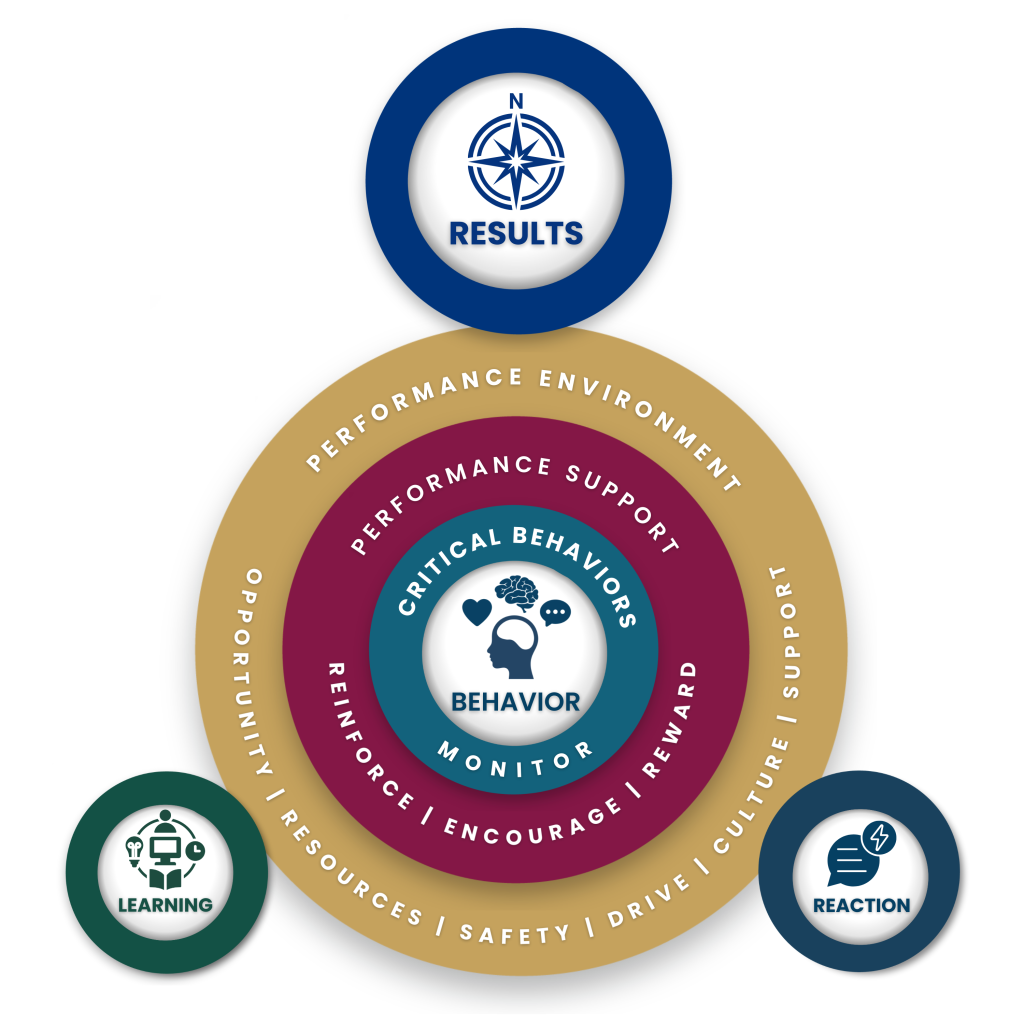
The Kirkpatrick Model

The Kirkpatrick Model gives organizations a framework/reference to bucket data together to identify the impact a program or initiative has on an overall organization.

At its core the Kirkpatrick Model breaks evaluation into four levels. These levels help you move beyond gut feelings to clear evidence of return from an individual’s reaction to organizational return/results. The Kirkpatrick Model is more than an evaluation checklist. It’s a holistic framework that helps organizations ensure initiatives deliver meaningful results. The four levels are linked, yet the model is not linear. It is cyclical: insights gathered at each level feed back into design, stakeholder alignment, and strategy. This turns evaluation into an ongoing engine of improvement, not a one-time report.

Level 4: Results


Level 4: Results measures the degree to which targeted organizational outcomes occur as a result of an experience or initiative and performance support.

Whenever applying the Kirkpatrick Model, it is critical to start with Level 4: Results, and understanding the “Why” and the purpose of the program and how it will affect the organization. 

At this level, you are evaluating the impact the program or initiative has made on the organization, and can be calculated in a variety of ways through various metrics including financially. 

Many feel Level 4 is the most difficult level to measure, however that is a common misconception. When setting up your metrics for Level 4: Results, we recommend identifying indicators (both leading and lagging) that will tell you if your program or initiative is making an impact. Most of your indicators are often times already tracked somewhere within the organization, and it is up to you to find where that data is stored and request to access the data to track in your own reports. 

Level 3: Behavior

Level 3: Behavior measures the degree to which the target audience performs the critical behaviors in its environment and is supported in and accountable for its performance. Components of Level 3 include critical behaviors, performance support, and the performance environment.

It is not enough to learn something, or be informed of something, application of the learning must be applied when the participant is back in their environment. When measuring behavior, you are measuring how the learning is transferring back to the environment, and cannot begin at 90 days after learning. With too much time between learning and measurement, you risk losing the opportunity to adjust and get the program or initiative back on track towards the intended end goal/result. 

At this level, the development and implementation of an accountability and support package that encourages the intended behavior is crucial to ensuring success. Accountability and support will look different per program or initiative, but may look like manager check ins, observations, job aids, rewards for performance, etc.

Level 2: Learning

Level 2: Learning measures the degree to which the target audience acquires the intended knowledge, skills, attitude, confidence, and commitment necessary to achieve the targeted outcomes.

Traditionally, Level 2: Learning is measured using pre- and post- tests, however there are many ways to measure learning that are better suited for different content types including role plays, teachbacks, etc. At Level 2, two new areas that are measured are confidence and commitment. These two indicators are early predictors of what may occur when the participant is back in their environment. 

Level 1: Reaction

Level 1: Reaction measures the degree to which the target audience finds an experience or initiative favorable, engaging, relevant, and supportive of the work needed to achieve the targeted outcomes. While Level 1 is not sufficient to tell you if behavior transfer will occur, you will have measurement on if there are any concerns or barriers that will affect transfer at this level. Most importantly at this level, is the measurement of relevancy. If a program or initiative is put in front of a participant that is not relevant to them, application will most certainly not occur. This is not to say engagement and favorability is not useful, however relevancy is the measure that more accurately indicates if behavior application and transfer will occur.

One traditional downfall of measurement of Level 1: Reaction is waiting until the end of a program to do a post-event survey. Instead, we advocate for formative evaluation solutions including pulse checks during the launch of the program or initiative, to give you the ability to course correct in real time.

The Performance Environment: The Hidden Driver of Results

The Performance Environment acts as both a foundation and an influencer. It can support or block progress at each level. Even the best-designed initiative may not succeed if the environment does not foster change. That’s why the new Kirkpatrick Model accounts for real-world conditions, not just what happened during a program.

Beyond ROI: Measuring What Matters

Organizations often ask for ROI because it sounds clear and definitive. But in complex systems, results are rarely caused by a single program or event. Performance and outcomes are influenced by multiple factors including leadership, systems, culture, timing, and parallel initiatives. That’s why the new Kirkpatrick Model elevates measures that are more realistic, useful, and aligned to how decisions are actually made. 

They include: 

Return on Expectations (ROE)
ROE starts with clarity at Level 4. Instead of imposing a predetermined metric, ROE is defined by key stakeholders, what they consider success, and established in advance. ROE ensures evaluation is focused on what matters most to the organization. 

Return on Performance (ROP)
ROP complements ROE by translating expectations into evidence. It examines whether people applied critical behaviors on the job (Level 3) and whether those behaviors contributed to targeted outcomes (Level 4). ROP supports continuous improvement by showing what is working and what needs adjustment. 

Contributive ROI (cROI)
When financial return is needed, cROI offers a more credible approach than trying to isolate training as the sole cause. It acknowledges contribution within a broader ecosystem and helps organizations communicate the portion of improvement reasonably linked to learning and performance efforts (without oversimplifying complex reality).

Integrated Return
Together, ROE, ROP, and cROI provide an integrated view of success: stakeholder-defined value, evidence of performance change, and a credible picture of contribution. This creates a clearer, decision-ready story of impact that is grounded in evidence, context, and how performance actually works.

The Evolution of the Kirkpatrick Model

The Kirkpatrick Model has evolved over the years to meet the realities of modern work. 

The model as created by Dr. Donald Kirkpatrick in the 1950s introduced the four-part structure: reaction, learning, behavior, and results. It shifted the field beyond attendance and satisfaction.

In the 2010s, Dr. Jim Kirkpatrick and Wendy Kayser Kirkpatrick emphasized Level 3 and business partnerships. They clarified definitions and taught the importance of planning from Level 4 to Level 1 (or starting with outcomes and working backward to design for them).

In 2026, Vanessa Milara Alzate expanded the model to include the performance environment, and naming that there are external factors and influences that affect whether training will transfer to behavior to then results. She also moved the model’s utility beyond training by updating definitions, and expanded the usability of the framework outside of just learning and development to apply it to the entire enterprise to encourage enterprise performance intelligence. 

The model’s greatest strength is its simplicity and flexibility, making it adaptable across industries, organizations, and program types.

A New Era of Evaluation

The Kirkpatrick Model helps organizations move beyond activity metrics and toward evaluation that supports real decisions, real performance, and real improvement. When these four levels are used together, and the environment is addressed, evaluation becomes part of the way organizations improve, not just the way they report.

Kirkpatrick Model Education


At Kirkpatrick Partners, we are the only source of authentic and up-to-date education on the Kirkpatrick Model. The model began with Dr. Don Kirkpatrick in the 1950s, and has undergone evolutions since then by Dr. Jim Kirkpatrick and Wendy Kayser Kirkpatrick, and even most recently by Vanessa Milara Alzate. As new research and education is found in the areas of adult learning, neuroscience, transfer, evaluation and measurement occurs, we strive to ensure that the Kirkpatrick Model is updated to meet the needs of today.

Become Kirkpatrick® Certified

We offer certification programs that allow you to learn the true model, the gold standard in assessing learning effectiveness, and gain a globally recognized certification that is often requested for job placements. Whether you are a seasoned professional or just starting out in your journey, becoming Kirkpatrick certified equips you with the tools and knowledge to elevate your career and impact. Join a community of over 14,000 and growing committed to driving organizational success through evidence-based evaluation practices.

Access Our Free Webinars

If you are looking for more information and education on the Kirkpatrick Model, check out our past webinars.

"The Kirkpatrick principles are essential to maximizing the transfer of learning to behavior and subsequent organizational results as well as to demonstrate the value of learning to the organization; unquestionably critical for any world-class institution!"
Dr. John Plifka
Director, Army Quality Assurance Program

FREE RESOURCES

Whether you are new to the training industry or a seasoned veteran, get access to the newest Kirkpatrick free resources and stay current on the latest trends in training evaluation and business partnership.